What is AMCA and Why it Matters for Louvres
When specifying façade components such as architectural louvres, performance data matters, but so does confidence in how that data is produced. In this blog, we explain what AMCA is, how its Certified Ratings Program works, and why specifying AMCA‑certified louvres benefits architects, consultants and contractors.
Who is AMCA?
The Air Movement and Control Association International (AMCA) is a not‑for‑profit, global organisation founded in 1917 and recognised as a leading authority in air movement and control standards.
AMCA represents manufacturers of air system equipment including fans, dampers, louvres, and air curtains, and has developed a range of test methods to verify product performance.
In addition, AMCA operates the Certified Ratings Program (CRP), a globally respected framework that ensures product performance claims are accurate, repeatable and independently validated.

The AMCA Certified Ratings Program (CRP)
Under the AMCA CRP, product performance is not simply tested once. Instead, certification follows a structured and ongoing process, giving specifiers confidence that published data remains reliable over time.
To be certified by AMCA, a product must:
- Be tested in an AMCA‑accredited laboratory
- Be tested under AMCA observation and approval
- Have performance data reviewed before publication
- Undergo regular check testing, typically every three years
- Be subject to ongoing monitoring of published technical information
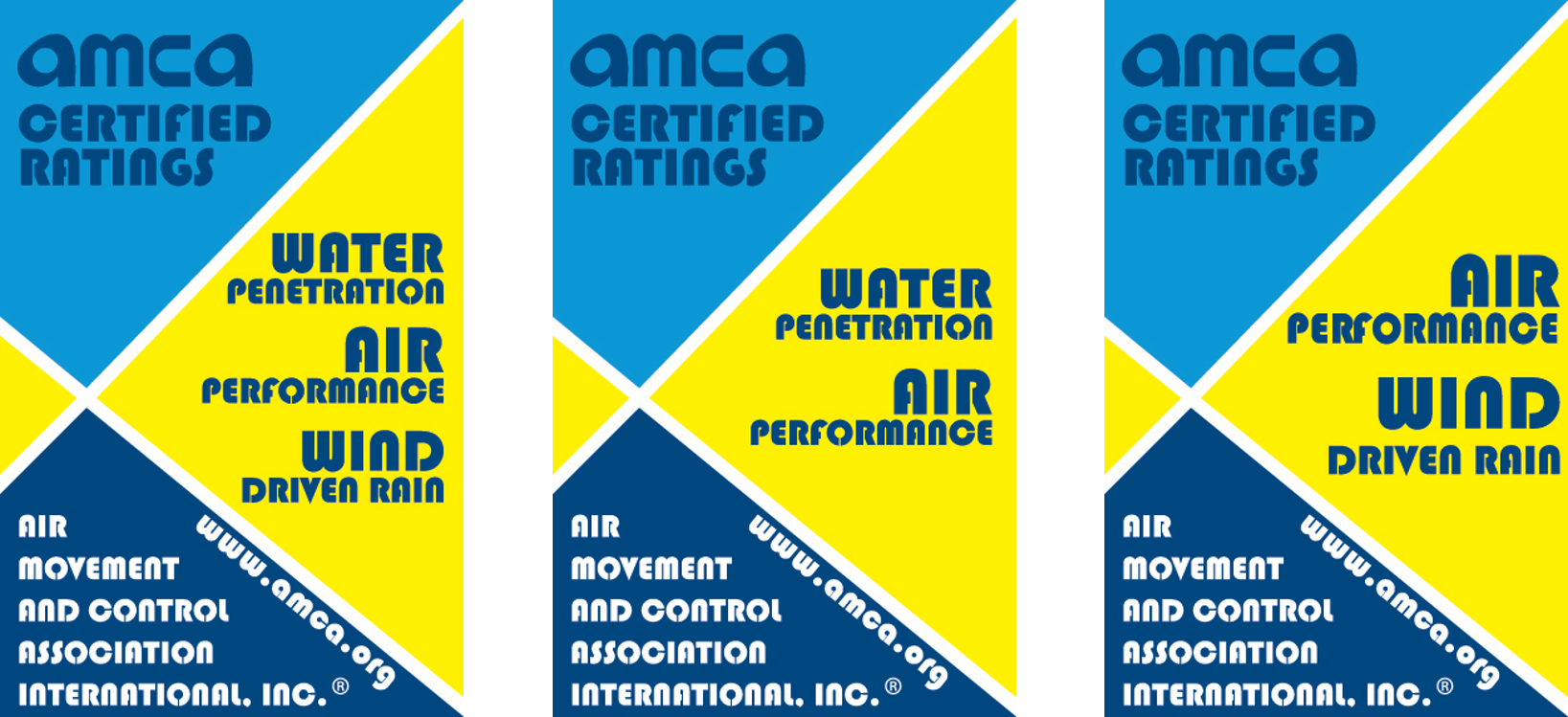
Certified products appear in AMCA’s online directory and may display the AMCA CRP seal, confirming that their performance has been independently verified.
It is worth noting that testing to an AMCA standard is not the same as being AMCA-certified. Certification includes review, oversight and ongoing compliance, not just a single test report.
Testing Louvre Performance
AMCA certification for louvres is based on ANSI/AMCA Standard 500‑L: Laboratory Methods of Testing Louvers for Rating. The standard defines methods used to assess performance under a range of operating and weather conditions.
AMCA 500‑L includes test methods for:
- Airflow performance (pressure drop)
- Water penetration under static rain conditions
- Wind‑driven rain
- Air leakage
- Wind‑driven sand
These tests are not pass or fail. They produce measured and comparable performance data. For louvres, the most commonly compared aspects of performance are: airflow, water penetration and resistance to wind-driven rain ingress.
Why Louvre Testing Is Important
Weather louvres form the first line of defence in a building façade. Their ability to manage air intake while limiting rainwater ingress is important for:
- Protection of plant rooms and building services
- Long-term façade durability
- Operational reliability, particularly in mechanically ventilated buildings
AMCA testing evaluates rain defence performance across a broader range of operating conditions than those required by the European standard for weather louvre testing, EN 13030. This provides specifiers with additional insight into performance at higher airflow rates and under more demanding weather exposure scenarios.
In addition, AMCA testing measures pressure drop in both intake and exhaust configurations, confirming a louvre’s true airflow performance. This ensures that sufficient airflow can be delivered to building services while maintaining system efficiency, something that can only be verified through testing and cannot be determined from percentage free area alone.

For a more detailed explanation of EN 13030 and AMCA 500-L louvre testing methods, see our guide to weather louvre testing.
Key Benefits of Specifying AMCA Certified Louvres
For architects, engineers and contractors, specifying AMCA‑certified products offers clear advantages:
- Independent verification – performance data is not self‑declared or based on one‑off testing
- More demanding conditions – wind‑driven rain testing evaluates performance at core velocities up to 5.0 m/s, with optional testing under severe storm conditions combining wind speeds of 22.3 m/s with 203 mm rainfall per hour
- Clear and consistent data – results are presented in a standardised format for transparent comparison
- More robust specifications – specifying AMCA‑certified louvres makes it more difficult for performance to be reduced through substitution
- Global consistency – particularly valuable for international clients such as data centres
Confidence Through Certification
As buildings become more complex and exposure to extreme weather increases, relying on independently verified data is increasingly important.
AMCA certification provides confidence that louvre performance is maintained throughout the product lifecycle.
Explore our range of AMCA Certified Louvres: